|
"
BELLA " celebrates life, changed lives

The
Washington Times
- Julia Duin
Sunday, December 28, 2008
Today
is the saddest of anniversaries.
Dec. 28 is known as the Massacre of the Innocents, named
after the slaughter of a whole city's worth of baby boys
younger than 2, ordered by King Herod when he was told by
the wise men that a messiah had been born in Bethlehem within
the past two years.
Although
Jesus - spirited out of town at night by his parents in
response to an angelic warning - managed to escape the carnage,
the rest of the male children were not so lucky. Their deaths
as the first Christian martyrs have always been observed
three days after Christmas.
Two
thousand years later, the massive taking of infant lives
has been applied to America's annual tally of 1.2 million
abortions.
Which is why I spent one night last week watching the 2007
movie "Bella," about a restaurant chef, Jose, who learns
that one of the waitresses, Nina, is unexpectedly pregnant.
When she announces her plans to have an abortion, he offers
to adopt her unborn child.
The
film ends four years later, with an iconic beach scene showing
Jose teaching an angelic little girl how to do cartwheels
in the sand. The scene is interrupted by the arrival of
Nina, who has come to see her daughter for the first time
since her birth. She breaks down in tears, realizing she
almost did not let her daughter live.
Every
life and every person makes a difference, says Tim Drake,
a senior writer for the National Catholic Register, who
recently wrote a book about the movie. Called "Behind Bella:
The Amazing Stories of Bella and the Lives It's Changed,"
it talks about a succession of providential incidents that
brought the low-budget film ($3 million) together. It has
grossed more than $8 million domestically and $3.3 million
overseas.
The
book points out that actress Tammy Blanchard, who plays
Nina, actually did get pregnant out of wedlock soon after
the film had been made. Whereas she felt having children
was "pointless" before appearing in the film, afterward
she realized the immensity of giving life. Her little girl,
Ava Jean, was born last December.
The
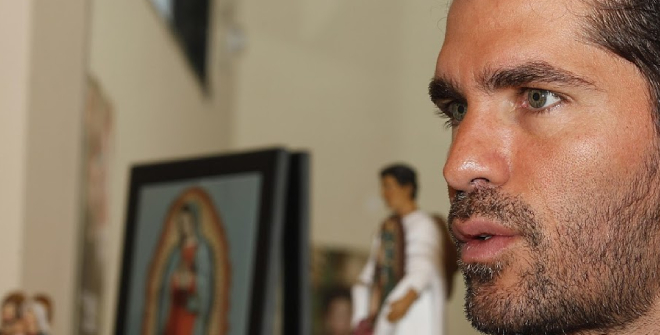
lead actor, Eduardo Verastegui, visited an abortion clinic
just before the film was shot so he could get an appreciation
for the plight of single, pregnant women. He ended up counseling
a young couple he met at the clinic who decided not to go
ahead with the abortion. Nine months later, little Eduardito
was born.
At
least 30 people who were planning abortions changed their
minds after seeing the film, Mr. Drake says, adding that
his mother was pressured to have an abortion when she was
pregnant with him 41 years ago.
"I've
talked with some post-abortive women who've seen the film,"
he said, "and they say, 'I wish I had had a Jose in my life
to encourage me.'"
He
became interested in "Bella" after it won the 2007 People's
Choice award at the Toronto Film Festival. Like the Christmas
movie "It's A Wonderful Life," the film "Bella" majors on
the theme of each existence having incredible meaning.
The
movie was an unlikely venture, as it was director Alejandro
Monteverde's first feature-length film. One of the key investors,
Sean Wolfington, was new at films. Mr. Verastegui had acted
mainly in Mexican soap operas.
"Filmmakers
and other folks made the film even though it didn't make
sense," Mr. Drake said. "When you say 'yes' to God, there
is always new life."
Julia
Duin's "Stairway to Heaven" column runs Sundays and Thursdays.
|